
Measuring the quality of family life on a daily basis is not just about counting the hours spent under the same roof. A longitudinal study published in 2023 in the Journal of Family Psychology shows that the time actually shared as a family, without screens or multitasking, has continuously decreased in Western countries since 2019, even as parents report spending more time at home.
This gap between perception and reality raises a specific question: what concrete levers improve family satisfaction on a daily basis?
Daily micro-rituals and family satisfaction: what the data shows
The study by McDaniel and Drouin (Journal of Family Psychology, 2023) identifies a clear protective factor: structured micro-rituals better protect family satisfaction than the raw amount of hours spent together. Shared meals, bedtime routines, and regular commutes constitute these micro-rituals.
This data puts into perspective the parental guilt related to a lack of availability. A parent who works a lot but maintains a daily meal ritual without digital distractions achieves, according to this research, better relational outcomes than a parent who is physically present but absorbed by a screen.
Several family configurations now coexist in France, as highlighted by the INSEE survey “Families and Housing 2024,” which documents a rise in multigenerational households since the pandemic. Families on Mister Papa share experiences regarding these varied configurations, where the cohabitation of grandparents, parents, and children profoundly alters the organization of daily rituals.
| Factor | Impact on family satisfaction | Source |
|---|---|---|
| Raw amount of time together | Low positive correlation | McDaniel and Drouin, 2023 |
| Structured micro-rituals (meals, bedtime, commutes) | Strong positive correlation | McDaniel and Drouin, 2023 |
| Co-viewing and co-playing digitally as a family | Protective factor for family bonds | WHO, recommendations 2023 |
| Physical presence with multitasking/screens | Negative correlation | McDaniel and Drouin, 2023 |
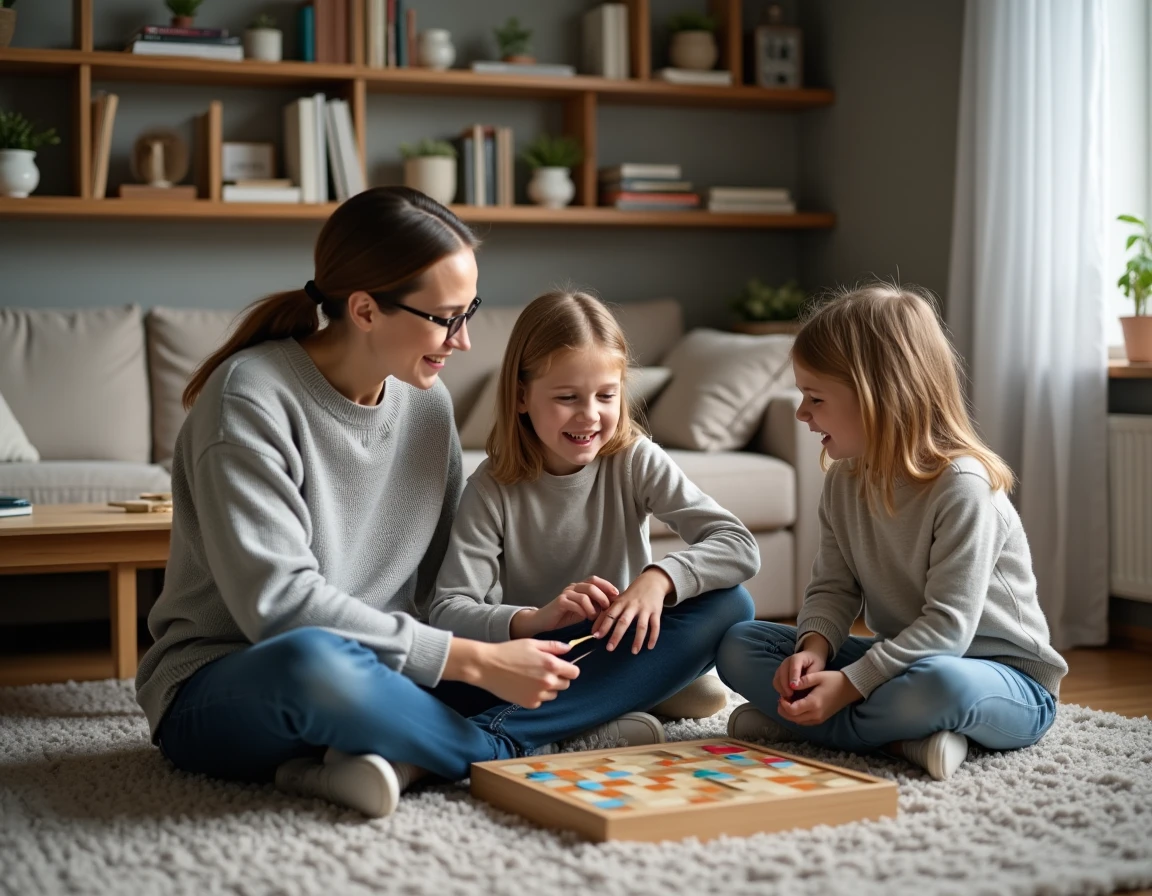
Screens in the family: the quality of use rather than the duration of exposure
The World Health Organization updated its recommendations on children’s and adolescents’ screen time in 2023. The key point: the quality of shared digital use matters more than the duration. Co-viewing, co-playing, and discussions about content are identified as protective factors for family bonds and mental health.
This approach opposes the binary logic of “screens = danger.” A parent who watches a documentary with their child and then discusses it actively contributes to the family bond. In contrast, two hours of tablet use alone without interaction do not provide the same relational benefit.
Differentiating passive use from interactive use
The operational distinction hinges on one criterion: is there a verbal exchange about the content? If so, the screen becomes a medium for a micro-ritual. If not, it fragments attention and reduces the time truly shared.
- Co-viewing (watching together and commenting) enhances mutual understanding between parents and children, according to the updated WHO recommendations.
- Co-video gaming, framed by discussions about strategies or emotions felt, serves as measurable quality time.
- Meals taken in front of a screen without verbal interaction diminish the protective value of the meal ritual identified by McDaniel and Drouin.
Multigenerational cohabitation: mental load and shared living rules
The INSEE survey “Families and Housing 2024” documents a structural phenomenon: the rise of multigenerational households in France, driven by the housing crisis and inflation. Grandparents, parents, and children under one roof change the mental load and cohabitation rules.
The benefits are tangible in certain areas: easier childcare, sharing some expenses, reassuring presence for the elderly. Frictions arise over other points: educational divergences between generations, management of personal space, negotiation of schedules.
Structuring rules rather than improvising
In a multigenerational household, the absence of explicit rules generates more tension than the rules themselves. Defining who manages what (groceries, meals, school support) and when each person has personal space reduces misunderstandings.
Multigenerational families that formalize their cohabitation rules report fewer conflicts related to mental load, according to findings from the INSEE survey. It is not physical proximity that poses a problem, but organizational ambiguity.

Couple life and parenting: two dynamics not to be confused
Parents’ emotions often spill over into the couple relationship, and vice versa. When family micro-rituals absorb all available energy, the couple loses its own structured moments. Preserving a couple ritual (a weekly meal without the children, a daily ten-minute discussion after bedtime) operates on the same principle as family micro-rituals.
Protecting couple time also protects family stability. Unexpressed marital tensions eventually alter the emotional climate perceived by children, who pick up on non-verbal signals long before words.
Family satisfaction is measured less in hours than in quality of attention. The data converge on one point: structuring a few short, fully invested rituals has a greater effect than multiplying activities without real connection. Families that formalize their shared time, adapt their digital use, and clarify their cohabitation rules have the most documented levers for living better together on a daily basis.