
In South Korea, the official age changes every January 1st, regardless of the actual birth date. This particular method of calculation has long created notable discrepancies between international age and Korean age, especially among celebrities.
The members of the group BTS were born between 1992 and 1997. Their age gap, often perceived as minimal, nonetheless influences the internal dynamics of the group and public perception. Understanding their seniority relies as much on chronology as on the social codes specific to K-pop.
Why does the age of BTS members intrigue fans so much?
In the K-pop landscape, every detail becomes a subject of attention, but the age of BTS members occupies a unique, almost obsessive place within the fan community. BTS, a flagship group composed of seven artists, has redefined South Korean pop by imposing its own generational references. The ARMY, the group’s fans, closely follow the evolution of these artists, from their early beginnings to the maturity they display today. This attention is not limited to Korea: in Paris, in New York, everywhere K-pop makes an appearance, the age of the members sparks debates, articles, and lively discussions on social media.
One figure: in 2026, the average age of idols is 22 years. BTS, however, has an average age of 31 years. This discrepancy is striking. In an industry that values youth, they stand out as an exception, and this uniqueness intrigues. Age not only determines internal hierarchy but also shapes roles and influences collective dynamics. Jin, the eldest, embodies a quiet authority, while Jungkook, the group’s “maknae,” retains a sense of freshness despite his stage experience. Each birthday becomes a shared event, both for the group and the community that follows them.
Social media amplifies this phenomenon: they bring idols closer to their audience, transforming biological information into a symbol. The age of BTS members thus becomes a ground for identification, projection, and sometimes even discussion around the frenetic pace and longevity on the K-pop scene. This direct link between BTS and the ARMY, this ongoing conversation, helps strengthen attachment and write a new chapter each year in their collective story.
The current age order of BTS members: who is the youngest, who is the eldest?
The generational diversity of BTS contrasts with the usual average age in the industry, set at 22 years in 2026. The composition of the group is not random: Jin, the eldest born in 1992, naturally occupies the position of big brother, ensuring a discreet but fundamental balance. His role is not merely honorary; it influences the work climate and group cohesion.
Here is the age order of BTS members, from oldest to youngest:
- Jin: eldest of the group
- Suga
- J-Hope
- RM
- Jimin
- V
- Jungkook: youngest, joined the group at 15 years old
The journey of Jungkook draws attention: joining BTS at just 15 years old means diving early into a demanding industry. This age difference nourishes the internal dynamics: the hierarchy, inherited from South Korean culture, is expressed in the distribution of responsibilities and daily support. The younger members, like Jimin or V, often rely on the experience of Jin or Suga. This fragile balance allows the group to remain united, despite external pressure.
In 2026, the average age of BTS is set at 31 years, a rarity in the K-pop universe where youth is often highlighted. This longevity raises questions about the notion of generation and evolution in an industry marked by constant renewal. Fans, for their part, accompany every step of this maturation, privileged witnesses to the individual and collective transformation of the group.
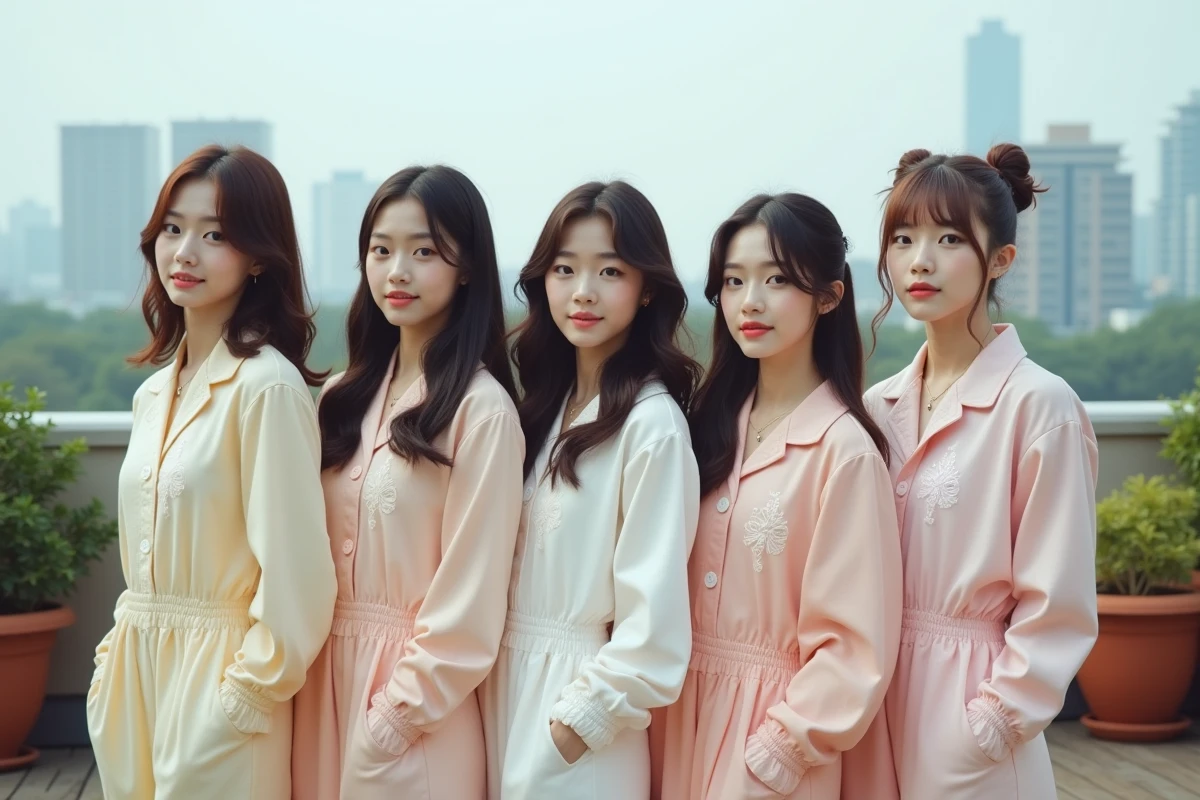
Age and hierarchy in K-pop: understanding their role in the global success of BTS
In the Korean music industry, age hierarchy is not just a matter of politeness. From the moment they enter training, trainees learn to respect their elders, demonstrate discipline, and cultivate team spirit. These rules, embedded in the DNA of labels, shape the experience of every K-pop idol. The journey of BTS is the most striking illustration of this.
Agencies recruit very young, sometimes as early as middle school, and impose contracts that can last up to fifteen years. Intensive training, the pressure of expectations, and constant competition forge strong bonds within groups. In this context, age takes on a structuring dimension: it determines who speaks, how conflicts are managed, and the distribution of roles.
In BTS, Jin occupies a reference position. His age gives him a certain authority while ensuring the stability of the group. At the other end, Jungkook, younger, embodies both the renewal of the group and the pressure to always be exemplary. This hierarchical organization, inherited from South Korean society, intrigues an international audience often captivated by the discipline and cohesion that result.
K-pop is not just about music. It is part of a set of codes where age, training, and team spirit forge unique trajectories. The success of BTS can be understood through this culture, where experience and youth constantly interact, under the watchful eye of fans and an ARMY that continues to grow. Time passes, generations succeed one another, but the strength of BTS lies in this rare balance: staying true to their values while traversing the years. Who would have bet, at their beginnings, on this exceptional longevity?