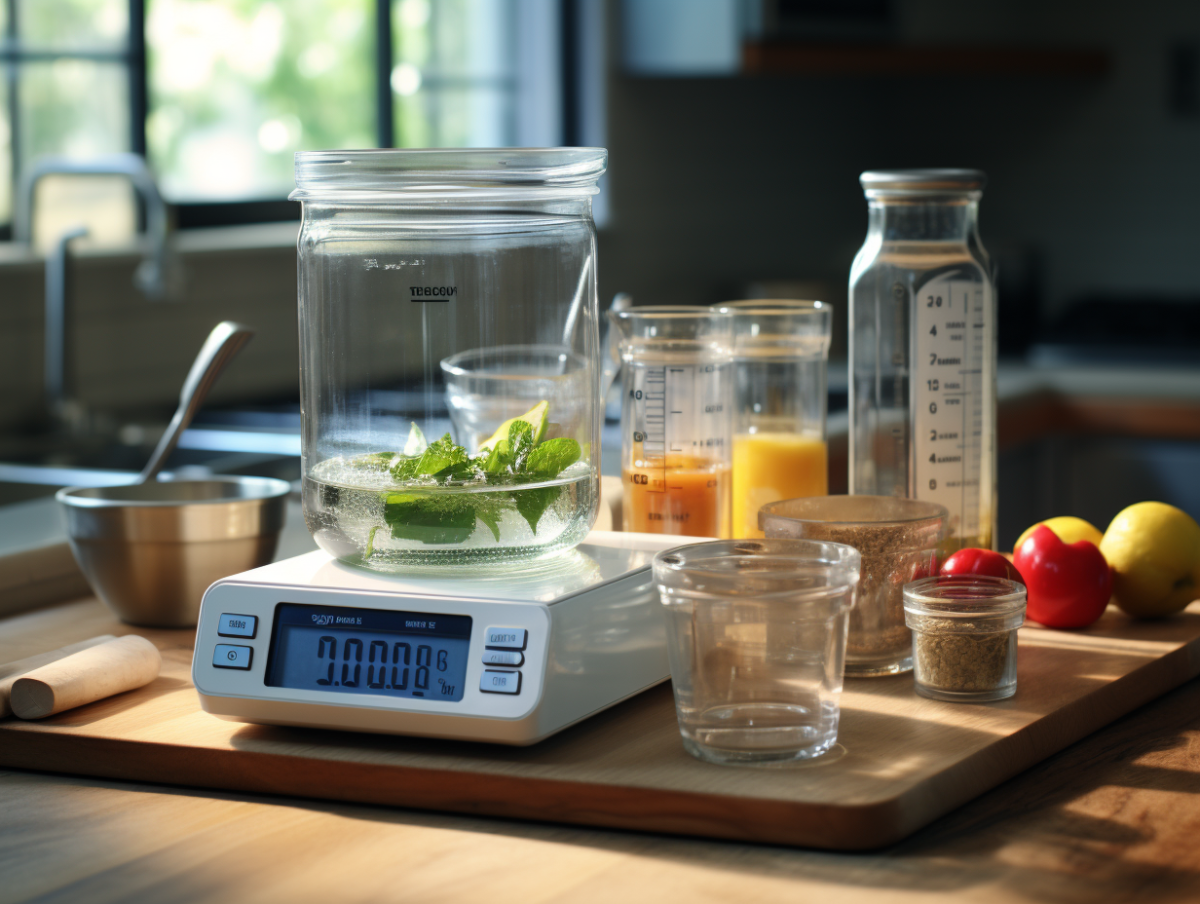
In the world of cooking, precision is key. For chefs and food enthusiasts, juggling between different measurement systems can be crucial for the success of a recipe. When it comes to converting volumes into weights, such as transforming liters into grams, you need to grasp the principles of liquid density, a fundamental concept in physics. This knowledge allows you to navigate smoothly between measurements and ensures that each ingredient is measured accurately, thereby guaranteeing the delicacy and refinement expected in any gourmet dish.
From Physics to Cooking: The Basics of Converting Liters to Grams
Density: this is the key term for understanding the conversion of volume to grams. This intrinsic property of a substance directly links the volume it occupies to its mass. Consequently, knowing the density of a liquid allows for easy conversion of liters to grams. Pure water, often used as a reference, plays a key role in this relationship: one liter of water, at a temperature of 4°C and under normal atmospheric pressure, has a mass of one kilogram.
The liter, the unit of volume measurement in the International System of Units, is precisely defined as equivalent to one cubic decimeter. This definition, shaped by the organization responsible for measurement standards, the BIPM, ensures global uniformity in recipes and scientific experiments. Conversion then becomes an exercise in rigor: for a given quantity in liters, multiply by the density of the substance in question to obtain its mass in grams.
However, it must be emphasized that density varies with temperature and pressure, and can differ from one substance to another. A liter of milk will not have the same mass as a liter of water. This variability requires constant vigilance in the kitchen, where the precision of quantities is key to success. A conversion chart or an accurate kitchen scale is often essential for adapting recipes accurately.
Units of Measurement: while the liter and kilogram are the pillars of conversion, do not forget the multiples and sub-multiples of these units. Milliliters and grams are commonly used in recipes for smaller quantities. When it comes to converting milliliters to grams, the same principle applies: use the density of the substance to calculate the corresponding mass. Keep these nuances in mind and ensure that your kitchen is a laboratory where precision is paramount.

Applying Conversion: Tips and Examples for Cooking
Mastering Density: this is the key to converting volume to mass accurately. In cooking, the density of each ingredient can vary, directly influencing the relationship between liters and grams. For example, a liter of milk is heavier than a liter of water due to its higher density. Understand the density of your ingredients to adjust your recipes precisely. A tablespoon of oil will not weigh the same as a tablespoon of syrup. These subtleties require special attention for cooks looking to perfect their dishes.
Using the Right Units of Measurement: milliliters and grams often dominate the culinary scene for small quantities. Knowing how to convert milliliters to grams is essential, especially when it comes to ingredients with variable density. Get into the habit of working with precise measuring instruments: kitchen scales for solids, measuring cups for liquids. The conversion of milliliters to grams will become second nature, ensuring the success of your preparations.
Adapting Conversions to Conditions: remember that the density of a substance can change with temperature and pressure. The weight of a liter of milk at room temperature will be different from that of refrigerated milk. This parameter is often overlooked, but it is essential for accurate conversion. The density, inherent to each substance, determines the amount of matter present in a given volume. In your kitchen, become a scientist: observe, measure, calculate, and adjust proportions so that your culinary creations are as precise as they are delicious.